
Introduction
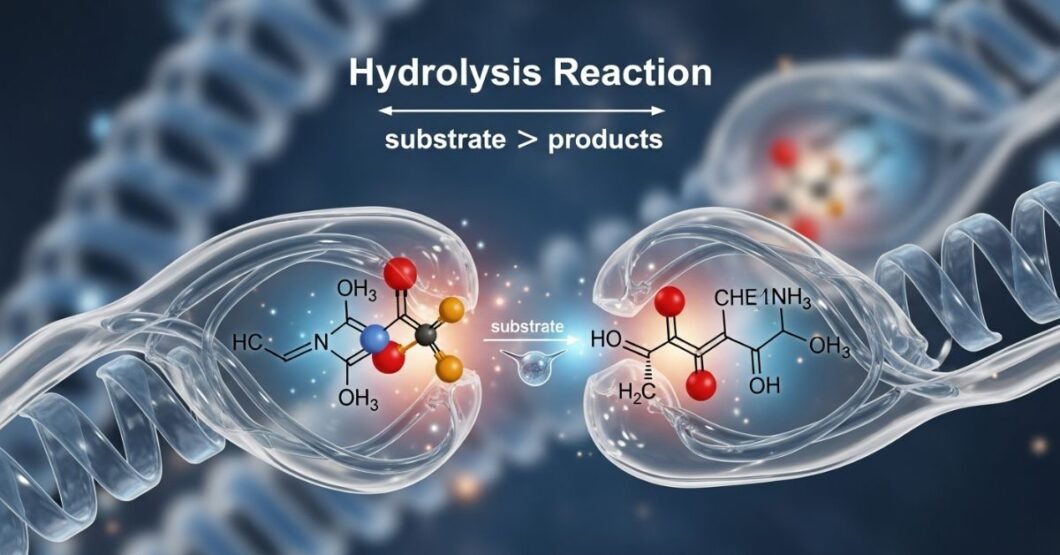
The classes of Enzymes are indispensable to life. These biological catalysts initiate and regulate nearly every chemical reaction that takes place inside organisms. From digestion to DNA replication, enzymes ensure that critical life processes occur efficiently and at the right time. In biology, learning about enzyme classes is essential because they are so important.
In 2026, as biotechnology, synthetic biology, and molecular diagnostics continue to evolve, a clear understanding of how enzymes function and how they’re categorized is more important than ever. Whether you’re a student, researcher, or simply curious about how life functions at a molecular level, this comprehensive guide breaks down the six primary enzyme classes and highlights their structure, mechanism, and real-world relevance.
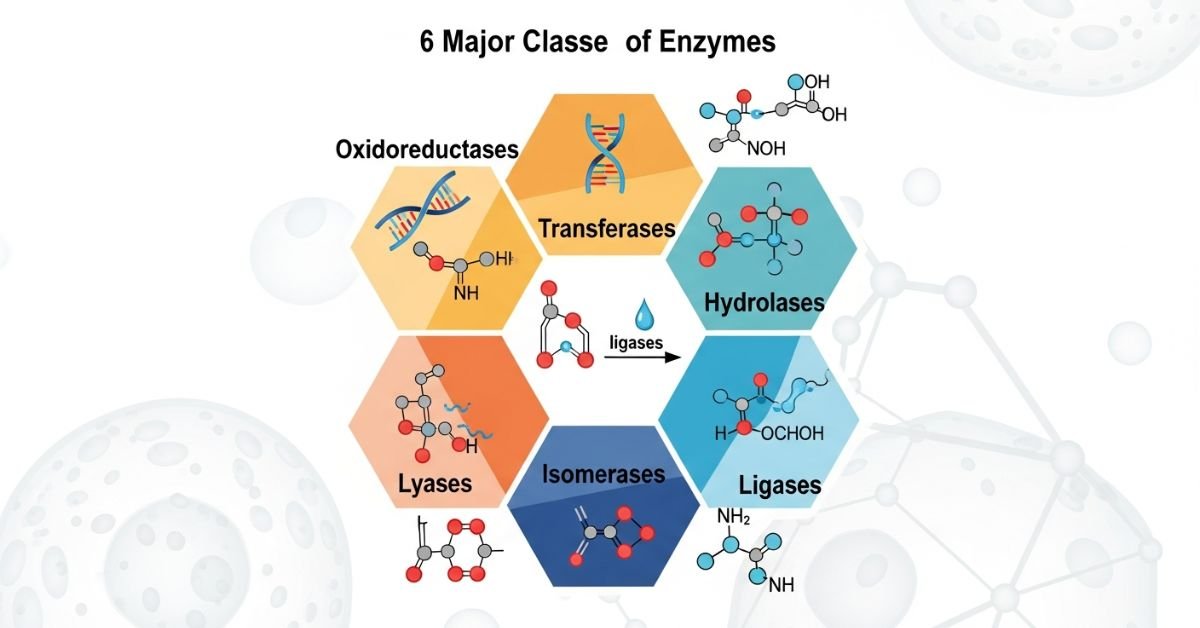
The Six Primary Classes of Enzymes
The classes of Enzymes are biological catalysts essential for life, categorized into six major classes based on the chemical reactions they facilitate. Oxidoreductases initiate electron transfers, driving oxidation-reduction processes, while Transferases relocate functional groups, such as phosphate or methyl groups, between molecules. Hydrolases utilize water to break chemical bonds, a process vital for digestion, whereas Lyases cleave bonds through non-hydrolytic means, often resulting in the formation of double bonds. Isomerases specialize in internal structural rearrangements, converting a molecule into its geometric or optical isomer. Finally, Ligases enable the synthesis of new bonds to join two large molecules together, a task that typically consumes energy in the form of ATP. This systematic classification, established by the Enzyme Commission, allows scientists to precisely identify an enzyme’s role within complex metabolic pathways.
Oxidoreductases: Catalysts of Electron Transfer
Oxidoreductases are enzymes that manage oxidation-reduction reactions, meaning they facilitate the transfer of electrons from one molecule (the reductant) to another (the oxidant).
Key Characteristics:
- Involved in energy generation and cellular respiration
- Commonly use cofactors like NAD⁺ or FAD.
- Function in mitochondria and chloroplasts
Examples:
- Lactate dehydrogenase (used in glycolysis)
- Cytochrome c oxidase (part of the electron transport chain)
EnzymeSubstrateRoleCatalaseHydrogen peroxideBreaks it into water and oxygen Alcohol dehydrogenaseEthanolOxidizes alcohol to acetaldehyde
These enzymes are critical for cellular energy metabolism and are heavily studied in medical and metabolic research.
Transferases: The Molecular Movers
Transferases catalyze the transfer of functional groups (like methyl, phosphate, or amino groups) between molecules. This ability makes them central to signaling pathways, gene regulation, and metabolism.
Functions:
- Crucial in biosynthesis (e.g., protein translation)
- Modify DNA and RNA in epigenetic processes
Examples:
- DNA methyltransferase (modifies genetic transcription)
- Alanine transaminase (used in amino acid metabolism)
Transferase TypeSubstrate ExampleFunctionKinase ATP adds a phosphate group. Acetyltransferase Acetyl-CoA adds an acetyl group.
Their versatility explains their significance in biomedicine and pharmaceutical targeting.
Hydrolases: Breaking Bonds with Water
Hydrolases utilize water to break chemical bonds, a process called hydrolysis. These enzymes participate in almost every decomposition process in living organisms.
Biological Importance:
- Fundamental to digestion (breaks down food)
- Involved in recycling cellular waste
- Act in DNA repair mechanisms
Examples:
- Amylase (breaks down starches in saliva)
- Lipase (digests fats in the digestive tract)
SubstrateProduct(s)EnzymeLactoseGlucose + GalactoseLactaseProteinsAmino AcidsPepsin, Trypsin
Hydrolases are the workhorses of many biochemical pathways.
Lyases: Breaking Bonds Without Water or Oxidation
Lyases cleave bonds without hydrolysis or oxidation. Instead, they add or remove functional groups to double bonds, usually without the involvement of water.
Unique Features:
- Often used in amino acid biosynthesis
- Play roles in metabolism and drug discovery
Examples:
- Fumarase (in the citric acid cycle)
- Histidine decarboxylase (forms histamine)
Enzyme TypeTypical ReactionDecarboxylaseRemoves CO₂SynthaseForms new bonds
Their ability to restructure molecules makes them valuable in synthetic chemistry and metabolic engineering.
Isomerases: Rearranging Without Adding or Removing Atoms
Isomerases convert molecules into their isomers structures with the same molecular formula but a different arrangement of atoms.
Where They Matter:
- Important in glycolysis and DNA replication
- Frequently found in metabolic loops
- Can act as stepping stones in synthesis pathways
Examples:
- Glucose-6-phosphate isomerase (gly
- Triose phosphate isomerase (energy metabolism)
EnzymeSubstrateIsomer FormedPhosphoglucomutase Glucose-1-phosphateGlucose-6-phosphate Epimerase Sugar epimersD-Galactose D-Glucose
Isomerases maintain internal balance within cells by finely tuning molecular structures.
Ligases: Bond Makers that Use ATP
Ligases catalyze the joining of two large molecules with energy input, typically ATP. These are crucial for DNA repair and replication where creating strong bond links is necessary.
Key Points:
- Require energy input to function (often ATP)
- Make phosphodiester or peptide bonds
- Vital in biotech applications (e.g., cloning)
Examples:
- DNA ligase (important in genetic engineering)
- Synthetases (build complex biomolecules)
Ligase TypeReaction CatalyzedDNA LigaseSeals DNA fragmentsGlutamine synthetase Adds ammonia to glutamic acid
Ligases are essential tools in biotech labs, diagnostics, and genomics.
Enzyme Class Summary Table
Class Name Reaction Type Real-Life ExampleUse in Research/Industry Oxidoreductases Electron Transfer Alcohol Dehydrogenase Drug detoxification Transferases Functional Group Transfer Kinase Cancer therapy targets Hydrolases Bond Cleavage via Water LactaseDigestive aids Lyases Bond Cleavage w/o Water Fumarase Metabolic cycle analysis Isomerases Structural Rearrangement Triose phosphate isomeraseMetabolomics Ligases Bond Formation with EnergyDNA LigaseGenetic engineering
Why Classifying Enzymes Is Foundational to Biology
Grouping enzymes into distinct classes isn’t just academic; it informs how drugs are developed, how diagnostics work, and how researchers simulate metabolic networks.
Understanding classes of enzymes helps:
- Predict enzyme activity in unknown reactions
- Develop biosensors, gene probes, and targeted treatments
- Optimize enzymes in industrial applications like fermentation or bioremediation.
The classification system, first organized by the International Union of Biochemistry and Molecular Biology (IUBMB), provides a universal format for enzyme nomenclature and discovery.
FAQ
How many classes of enzymes are there?
Six major classes are recognized by IUBMB.
Which enzyme class breaks down biomolecules using water?
Hydrolases.
What enzymes are used in DNA replication?
Ligases (to join strands) and isomerases (to unwind structures).
Are all enzymes proteins?
Most are proteins, but some RNA molecules (ribozymes) also act as enzymes.
Why do we need to classify enzymes into groups?
It makes understanding their function easier, simplifies research, and supports biotechnological development.
Conclusion
Learning the six core classes of enzymes gives you a blueprint for understanding life’s complex chemical reactions. From diagnostics to energy production, every field of biology depends on enzymatic activity and by extension, on these classifications.
Whether you’re a biology student, researcher, biotech founder, or medical professional, deepening your knowledge of this enzyme taxonomy is essential. As research continues in enzymatic engineering and synthetic biology, this foundational knowledge will remain a cornerstone of both understanding and innovation.